The Aaron Judge 2013 Bowman Chrome Draft Superfractor — serial numbered 1/1, graded PSA 9 — crossed the auction block at $838,750. Not a painting. Not a piece of jewelry. Cardboard and ink, roughly the size of your palm.
So what makes that possible? There's an old saying: “Something is worth what someone else is willing to pay for it.” And while that's technically true, it's a lazy answer when you're talking about sports cards and collectibles. Because behind every significant sale, there are several distinct forces at work — and understanding those forces is what separates a serious collector from someone who just got lucky, or unlucky.
Let's break them down.
Scarcity & Print Runs: Basic Supply and Demand
This one is Economics 101, but it hits different when you're holding a card numbered /10.
The modern card market is built on manufactured scarcity. Unlike the overproduced junk wax era of the late '80s and early '90s — when Topps and Donruss printed cards by the billions — today's releases are carefully tiered. You've got your base cards (printed by the millions), your parallels (printed in the hundreds), your numbered short prints (printed in the tens), and then… the grails.
Serial-numbered cards put scarcity right on the face of the card. A card numbered /25 means there are exactly 25 in existence. A card numbered /10 means ten. And a 1/1 — the “one of one” — is the pinnacle. Superfractors, printing plates, sketch cards: these are the cards that make people do wild things at auction. The remarkable thing about 1/1s is that even an unknown player can carry a significant price tag — because the scarcity alone is its own story.
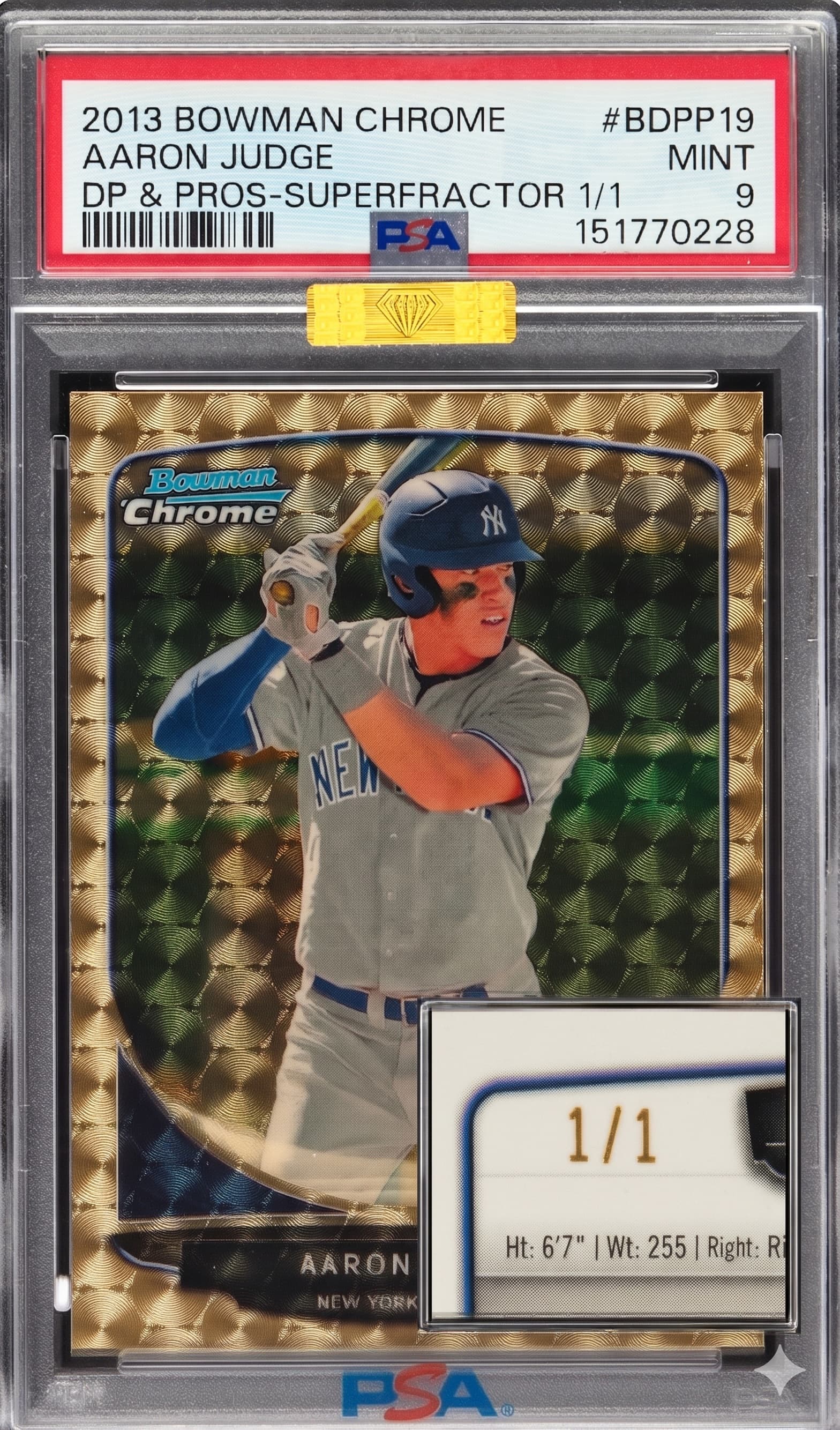
Browse recent 1/1 Superfractor sales on eBay →
If you want to see how print run tiers play out in a real product, our 2026 Bowman pack breakdown shows exactly how odds differ across box types — and how dramatically scarcity affects what you should actually be chasing.
Then there's vintage scarcity — which is a different animal altogether. A 1952 Topps Mickey Mantle wasn't printed in limited quantities on purpose; it's scarce because most of them were thrown away, water-damaged, or beat up over the last 70+ years. The ones that survived in good condition are rare by attrition, not by design. Population reports from grading companies like PSA help quantify just how rare — when PSA tells you there are only 3 copies of a given card grading PSA 8 or higher, that number carries real weight.
The Player Behind the Card: Where Hype Lives
If scarcity is the supply side of the equation, the player is the demand side. And demand in this hobby runs on hype.
Hype is the feeling that this could be the next Trout, the next Ohtani. It's the speculative bet on a prospect who hasn't proven anything yet, or the wave of excitement behind a player who just did something you've never seen before. And when hype hits, it hits fast.
Exhibit A: Nick Kurtz. On July 25, 2025, the Oakland Athletics rookie became the first player in MLB history to hit four home runs in a single game as a rookie. He went 6-for-6, tied the all-time record with 19 total bases, and did it at age 22 — the youngest player ever to accomplish the feat. By the next morning, his rookie cards were selling at multiples of what they'd been 24 hours earlier.
See Nick Kurtz rookie card sales on eBay →
Exhibit B: Cam Schlittler. In October 2025, the Yankees pitching prospect made his Wild Card debut and threw 8 scoreless innings against Boston — 12 strikeouts, zero walks, a statline that had never happened in postseason history. One day before that start, his 1st Bowman refractor auto numbered /499 was selling for around $200. Two days later? The same card was fetching $500–$700. That's the hype machine in real time.
Check Cam Schlittler card sales on eBay →
Of course, hype cuts both ways. For every Kurtz or Schlittler, there are ten prospects who flame out. The card you paid $300 for because he was ranked #1 in Baseball America? Worth $8 after he got released. Bust risk is real, and it's the thing that separates a savvy collector from someone who got burned chasing the next big thing.
The longer-term value story is built on sustained performance: career milestones, championship rings, Hall of Fame votes. The journey starts at the draft and major prospect list releases, continues through MLB debut, and compounds through every record and ring that follows. Rookie cards serve as the floor of a player's legacy — if he becomes great, people want the card from before the world knew he was great. That dynamic never really changes.
Cultural Moments & Hype Cycles: When the World Pays Attention
Individual players drive value, but the broader hobby ebbs and flows with cultural moments — and sometimes, pure market forces.
Viral performances create immediate demand spikes. Social media and hobby influencers amplify them instantly. A single tweet or YouTube video from a hobby personality can move markets on cards most people hadn't heard of an hour earlier.
And then there's investor money. Shark Tank's Kevin O'Leary — “Mr. Wonderful” himself — made headlines in August 2025 when he led a $12.93 million purchase of a rare dual Logoman card featuring Kobe Bryant and Michael Jordan, breaking the previous record for the most expensive trading card ever sold at auction. He's been building what he describes as a “massive portfolio” in the space, with cards priced between $600K and $1.7M each. His argument? Eleven years of trading card data, combined with projections of $1 billion in annual card sales, convinced him this isn't a fad. By early 2026, the syndicate he formed was reportedly offered $21 million for that same Kobe-Jordan card.
“Tell me an asset class that does better.” — Kevin O'Leary, on his sports card portfolio
When this kind of money enters the hobby, it changes the math for everyone. And when it leaves — or when the next viral moment fails to materialize — prices can come back to earth just as fast.
We saw this clearly during the 2020–21 boom. The pandemic hit, people were stuck at home, stimulus checks were flowing, and sports cards became both a pastime and a perceived investment vehicle. Prices went parabolic. Then the world reopened, interest rates rose, and a lot of speculative money left the building. Some of those pandemic-era prices never came back. Was it a bubble? Partly. Was it also the beginning of a new era of mainstream hobby acceptance? Also yes. The answer is probably both.
Condition & Grade: The Science of Perfection
Here's where the hobby gets precise in a way that surprises newcomers.
A card's condition isn't binary — it exists on a spectrum, and small differences can mean enormous price gaps. Centering (is the image centered within the borders?), corners (sharp or dinged?), edges (clean or chipped?), and surface (scratches? print lines?) all factor into a professional grade.
The major grading companies — PSA, BGS (Beckett), and SGC — assess these attributes and assign a numeric grade, typically on a 1–10 scale. A PSA 10 “Gem Mint” commands a premium that can be staggering. On popular cards, the difference between a PSA 9 and a PSA 10 isn't 10% — it can be 3x, 5x, or more. Population reports add another layer: if PSA has only ever graded 12 copies of a specific card at PSA 10, that scarcity layered on top of the grade creates a genuinely rare item.
The decision to grade a raw card involves cost and timing tradeoffs. For a primer on whether grading makes sense for your collection, check out our Collecting 101 guide. And when you're ready to think about when to submit, our grading timing guide explains why the moment you submit can matter as much as the grade you receive.
Browse PSA 10 graded baseball card sales on eBay →
💡 Did You Know? Autographs Can Be Graded Too
It's not just the card that can be certified — the signature itself can be graded. Companies like JSA and PSA/DNA assess both authenticity and the quality of the autograph, adding another certified dimension to a signed card's value. A clean, bold signature through the sweet spot? Premium. A lazy scribble off to the side? Considerably less so.
This matters a lot at higher price points. We cover it in detail in our Collecting 101 guide.
Nostalgia & Emotional Premium: The Stuff That Can't Be Quantified
Not everything in this hobby is about ROI. In fact, for a lot of collectors, the emotional dimension is the whole point.
There's a reason a 45-year-old guy will overpay for a Dale Murphy card. He grew up watching Murphy hit bombs at Fulton County Stadium. That card means something to him in a way that no spreadsheet can capture. Nostalgia is a real premium, and it creates regional demand that sometimes defies national market logic.
There's also the concept of the Personal Collection (PC) — the players or sets you collect not because you're speculating on their upside, but because they're yours. Some people PC based on childhood fandom. Some chase a prospect they believe in. Some are set collectors who love the hunt of completing a run. And some are pure investors who treat it like an alternative asset. All of these are valid motivations. Knowing which one you are — and being honest about it — is actually pretty important when you're deciding what to buy and at what price.
Cardboard as an Asset Class: Let's Be Real
Sports cards can appreciate in value. Some do so dramatically, as we've seen. But this is not the stock market. There is no ticker symbol. There is no instant liquidity. When you need to sell a card quickly, you're at the mercy of whoever happens to be looking for that specific card on that specific day.
Platforms like eBay, PWCC, and Alt have dramatically improved price discovery — you can see actual sold comps, not just wishful asking prices. But there's still a meaningful gap between “my card is worth $500” and “I can get $500 for my card today.”
The honest answer to “are cards an investment?” is: for some people, with some cards, yes — but most people in this hobby are collectors first, and that's a completely valid reason to be here.
Supply-Side Surprises: When the Card Itself Becomes the Story
Sometimes value is created not by the player or the market, but by the card itself.
Short prints — intentionally produced in smaller quantities within a set — create built-in chase cards that drive box break interest and secondary market activity. Redemption cards (certificates exchangeable for a signed card to be produced later) trade with their own volatility, often at a discount due to uncertainty about when — or whether — the physical card will arrive.
And then there are error cards. These are unintentional legends.
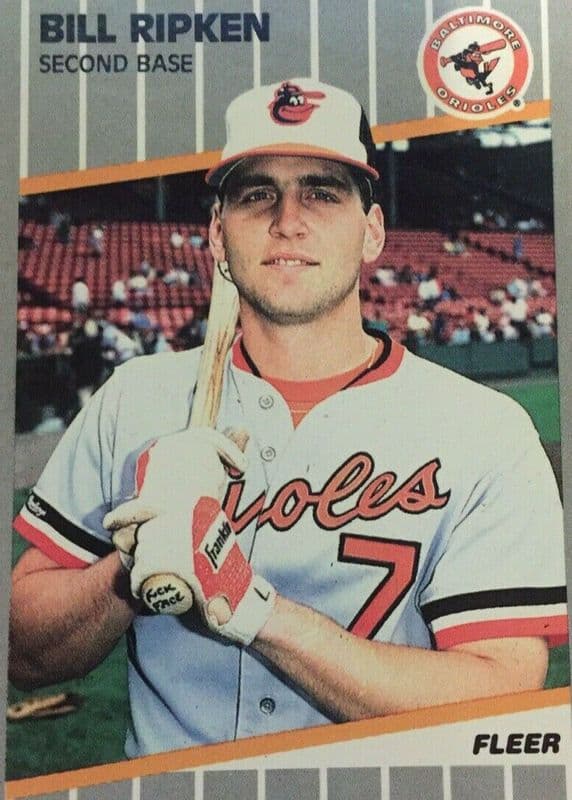
The 1989 Fleer Billy Ripken card is the most famous example. An obscenity written on the knob of his bat made it through quality control and into millions of packs. It became a collectible almost overnight, and multiple variations now exist depending on how quickly — and how effectively — Fleer tried to correct the print run. The original uncorrected error cards, paradoxically, became more valuable than the corrected versions. Oops became opportunity.
See Billy Ripken error card sales on eBay →
The “It” Factor: What Makes a Card Beautiful
Beyond the numbers, there's pure aesthetics — and it matters more than people admit.
Card design matters. The photography matters. A dramatic action shot from a defining game moment hits differently than a posed studio photo. Inserts and parallel sets are frequently treated as miniature works of art, and there are collectors who buy purely on design merit regardless of the player.
Patch cards — where a swatch of actual game-worn jersey is embedded in the window of the card — add yet another chase element. A prime patch (multiple colors, a team logo, a jersey number) from a meaningful game tells a story that goes beyond the cardboard itself.
And finally, there's the brand and license question. Topps holds the exclusive MLB license — meaning Bowman Chrome, Topps Heritage, and Stadium Club all carry official logos and team branding. Panini (home of Prizm, Select, and National Treasures) lost their MLB license and now produces baseball cards without official team branding. Both camps have passionate collectors — but it's a real distinction in the market, and it affects how cards are perceived and priced.
Free · Weekly
Get More Like This in Your Inbox
Inside the Vault covers market movers, hobby deep-dives, and the intel serious collectors actually need — every week, free.
Subscribe Free →The Recipe for Value
Here's the way I think about it: card value is a recipe, not a formula. The ingredients are:
Scarcity
How many exist? Serial numbers, population reports, and survival rates all tell this story.
Story
Who is this player, and what have they done — or what might they do? Performance drives narrative, and narrative drives demand.
Sentiment
Why does this card matter to someone? Nostalgia, fandom, and emotional connection are as real as any market signal.
Every truly valuable card has all three. A 1/1 of an unknown prospect has maximum scarcity and zero story. A mass-printed base card of an all-time great has maximum story and zero scarcity. The magic happens when all three ingredients are dialed in at once — when you have a card that's rare, features a player with a compelling narrative, and resonates emotionally with the people who want it most.
That's when cardboard sells for $838,750.
And it's why people like us keep chasing.